
Key Takeaways
- Red, green, and white Maeng Da all come from the same grafted strain.
- Vendors tie white to the earliest harvest, green to mid-maturity, and red to the most mature leaf.
- No color is the “strongest” every time. The lab report tells you far more than the label.
- Health Canada hasn’t approved kratom for human consumption, so Big Bear Kratom sells every batch for research purposes only.
Red, green, and white Maeng Da all sit on the same product page, carry the same name, and usually cost the same. So which one should you pick? The product descriptions don’t help much, since most of them read alike, and searching online turns up a different opinion every time you look.
Here’s the part that usually gets left out. The color has nothing to do with flavor or quality grade. It comes from the leaf, or more specifically, from how long the leaf grew on the tree before a farmer picked it. Once you know that, picking a Maeng Da kratom color gets easier.
Table of Contents
- What Makes Maeng Da Different
- What the Vein Color on the Label Means
- Red, Green, and White Maeng Da Side by Side
- How to Choose Between Red, Green, and White
- Why the Lab Report Tells You More Than the Color
- Pick Your Maeng Da Color and Size
- Frequently Asked Questions
What Makes Maeng Da Kratom Different

The name is Thai, and the kratom trade has long linked it to a high-grade reputation. What makes it unusual is its origin. Growers created it by grafting, which means joining tissue from two Mitragyna speciosa trees so they grow as one plant. Red Bali and Green Malay, by comparison, come from trees that grew naturally.
You can often spot the leaf by its edges. They’re jagged, almost horn-like, where most kratom leaves are smooth. These days, most Maeng Da is grown in Thailand and Indonesia, and Big Bear Kratom carries Maeng Da in all three vein colors, all sourced from Southeast Asia.
What the Vein Color on the Label Means
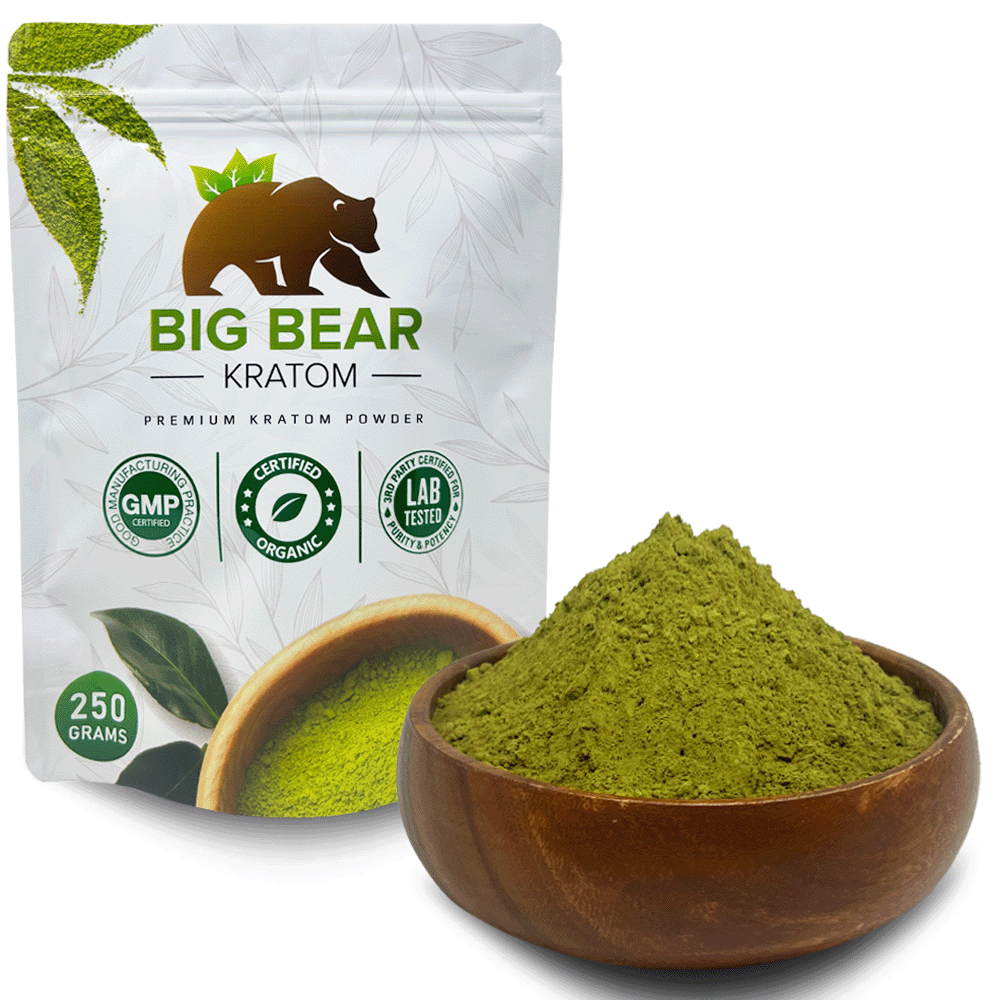
Every kratom leaf has a thin vein down the middle. In the kratom trade, vendors link the color of that vein to how mature the leaf was when someone picked it. White sits at the early end, green in the middle, and red at the late end. That’s how one Maeng Da kratom strain ends up in three different pouches.
The three are also closer than their labels suggest. Researchers at Mulawarman University in East Kalimantan, Indonesia, compared red, green, and white vein leaves and found the same major groups of plant compounds in all three, with alkaloids, flavonoids, and tannins among them.
White Maeng Da
This is the earliest harvest, and it mills into the lightest powder of the three. White Maeng Da is commonly selected for daytime research sessions. It sits alongside a wider group of white vein kratom strains from Southeast Asia.
Green Maeng Da
These leaves come off the branch at mid-maturity. The profile is usually described as balanced, somewhere between white and red. That middle spot is why green Maeng Da often serves as a reference point before buyers look at other green vein kratom strains.
Red Maeng Da
These leaves stay on the tree the longest, and the powder comes out darker, closer to a reddish brown. Red Maeng Da is commonly selected for evening research sessions. It belongs to a big family of red vein kratom strains grown across Southeast Asia.
Red, Green, and White Maeng Da Side by Side
Here’s a quick look at how red, green, and white Maeng Da compare. The details below reflect how vendors generally describe each color, and individual batches can vary.
| Color | Harvest Stage (as Described by Vendors) | Powder Color | General Profile | Often Chosen For |
| White | Earliest | Lightest of the three | Distinct, furthest from red | Daytime research sessions |
| Green | Mid maturity | Green | Balanced, between white and red | Daytime or evening sessions |
| Red | Most mature | Darker, reddish brown | Distinct, shaped by longer maturity | Evening research sessions |
Every row describes the same grafted leaf, picked at a different point. Not a different plant. Timing is also why red and green Maeng Da differ in processing, not only in color.
How to Choose Between Red, Green, and White

There isn’t a single best Maeng Da strain for everyone, since each color comes from a different stage of the harvest. The right pick depends on what you’re trying to compare.
- Choose green if you want a midpoint for comparing the other two.
- Choose white if you want to study the earliest harvest and the lightest powder.
- Choose red if you want to study the most mature leaf and the darkest powder.
- Choose all three if you’d like a full side-by-side comparison in one order.
On size, a 25 gram pouch is enough for a first look at one color. A 100 gram pouch gives you room for a longer comparison. And if you’d rather have everything at once, the 300g Beginner’s Pack lets you pick red, green, and white Maeng Da as your three 100 gram pouches, for $75.
Why the Lab Report Tells You More Than the Color

Vein color gives you a general idea, but it can’t tell you exactly what’s in a batch. A study from Kasetsart University in Thailand found that mitragynine levels in kratom leaves varied by more than three times, depending on things like sunlight, humidity, and soil.
So Big Bear Kratom has its Maeng Da kratom independently tested before it ships. The lab checks each lot for heavy metals, pesticides, mold, bacteria, and alkaloid content, and you can ask for the certificate of analysis on your batch.
Pick Your Maeng Da Color and Size
Big Bear Kratom is an Ontario-based vendor that ships across Canada, so if you’re shopping for Maeng Da kratom Canada wide, all three colors sit in one place. Each comes in five sizes, from a 25 gram pouch up to a full kilogram, priced between $10 and $175 CAD. Orders over $80 ship free, and a 30-day satisfaction guarantee covers every order.
Health Canada hasn’t approved kratom for human consumption, so every pouch ships for research purposes only. Once you’ve picked a color or decided you’d rather compare all three, Big Bear Kratom has red, green, and white Maeng Da kratom ready to ship in every pack size.